
-

-
Unzen jigoku Martyrdom
2024/02/15
● Christian Pilgrimage sitesWhen Matsukura Shigemasa became the new federal lord of Shimabara in 1616, many people were Christians. Initially, he acquiesced in Christianity, because he needed people’s cooperation to build Shimabara Castle. However, this situation was known to Tokugawa Shogunate, and he strongly commanded Christians in Shimabara to convert. From 1627, Christians who did not convert were persecuted using the boiling water of Unzen jigoku. Many Christians were taken to this Unzen jigoku and martyred. Unzen Church is dedicated to Father Antonio Ishida, a martyr of Unzen Hell, and martyrdom festival is held every May. Unzen jigoku is a tourist spot in Unzen. Jigoku, means Hell, is the number one attraction of Unzen with a peculiar smell of sulfur emitted from the springs, and boiled hot water and white smoke rising from the ground over a wide area. This is a striking reminder that Unzen Volcano is still very much alive.
-
-
Saint Filippo de Jesus Church ( Japan 26 Saints Memorial Church ), in Nagasaki
2024/02/14
● Churches and CathedralsThis is a church with Gaudi-style twin tower designed by Kenjiro Imai, built next to the Nishizaka Martyrdom site When there was a plan to build a memorial hall for the 26 Japanese Saints next to Nishizaka Martyrdon site, a large donation was made from Mexico, and the Church was built in 1962. This church is dedicated to Mexican Filippo de Jesus, who is one of the 26 Saints. Filippo de Jesus was a Franciscan Catholic missionary who became one of the 26 Martyrs of Japan, the first Mexican Saint.
-
-
Kurose no Tsuji, martyrdom site of Gaspar Nishi Genka
2024/02/10
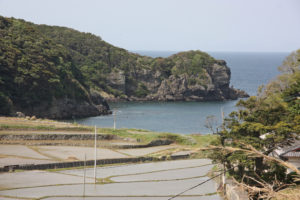
● Christian Pilgrimage sitesThe site where Christian Gaspar Nishi Genka was martyred in 1609, located on Kurose Hill overlooking Nakae no shima between Hirado and Ikitsuki. The tomb facing the sea is called Gaspar-sama and is a revered place for Ikitsuki’s Hidden Christians. The cross-shaped “Kurose no Tsuji Martyrdom Monument” was erected by Catholics in 1991, and Mass is held every year around November 14th. Gaspar Nishi Genka was the first martyr of Ikitsuki and the father of Thomas Rokuzaemon Nishi who was one of the 16 Saint of Nagasaki, dedicated in Nakamachi Church in Nagasaki.
-
-
Hidden Christian site, Kasuga Village
2024/02/12
● Christian Pilgrimage sitesKasuga Village and Mount Yasugatake is a Christian Pilgrimage site and is registered on the World Heritage as Hidden Christian Sites in the Nagasaki Region. This idyllic, remote village was refuge to a small community of Hidden Christians who practiced here for centuries, far from the prying eyes of the government. After the ban on Christianity was lifted, the local villagers decided to continue practicing their own unique brand of the religion rather than rejoin the Catholic Church. As a result, churches were not erected in the village, and the religion remains outwardly invisible.
-
-
Japan’s first Seminary
2024/02/14
● Christian Pilgrimage sitesIn 1579, Priest Alessandro Valignano of Jesus from Portugal came to Japan to inspect the situatin of missionary work in Japan. Valignano believed that training Japanese priests and monks was the key to the success of missionary work in Japan. And then, he made the Japan’s first Seminary in Shimabara peninsula in 1580, where was the Hinoe Castle town of Arima Harunobu. Among the first students, included member of Tensho youth mission to Europe who were Ito Mansho Ito, Chijiwa Miguel, Hara Martino and Nakaura Julian. Note : Seminary is an educational institution established in Japan by the Society of Jesus between 1580 and 1614 to train Jesuit priests and monks.
-
-
26 Saints Pilgrimage route on January 27 in 1597
2024/02/14
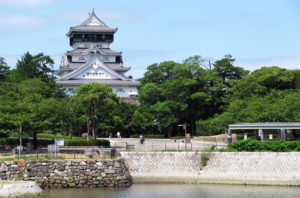
● Martyrdom of the 26 Saints of JapanThere were 24 martyrs when they started Kyoto, but two more martyrs were added in Shimonoseki, then became 26 martyrs in total. The route of this day was from Karato in Shimonoseki to Kokura in Kitakyushu. Rode on the boat at Karato, and transfer to Dairi in Kitakyushu Karato Kanmon Strait Dairi They landed at Dairi and walked 6 km along the coastline of Kanmon Strait to Kokura, where was the place to stay. It is said that they stayed around Kokura Castle.
-
-
26 Saints Pilgrimage route on January 28 in 1597
2024/02/13
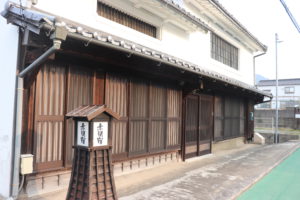
● Martyrdom of the 26 Saints of JapanThe route of this day was from Kokura in Kitakyushu to Akama in Munakata via Koyanose , the distance was 34.5 km. Started at Kokura accommodation around Kokura Castle, and walked to Tobata port along the Kanmon Strait. Transfered to Wakamatsu from Tobata by a boat. Walked to Akama through Ashiya and Koyanose, and then stayed at Akama.
-
-
Shimabara Peninsula Martyrs Memorial Cathedral, in Shimabara
2024/02/14
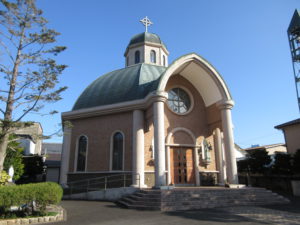
● Churches and CathedralsThis Cathedral is house of prayer for tens of thousands Christians who were martyred between 1612 and 1658 throughout the Shimabara Peninsula. It was built in 1997 to commemorate the 400th anniversary of the martyrdom of 26 Japanese Saints and the 360th anniversary of the Shimabara Rebellion. The Cathedral is a beautiful octagonal building with a large octagonal dome.
-
-
26 Saints Pilgrimage route on January 29 in 1597
2024/02/12
● Martyrdom of the 26 Saints of JapanThe route of this day was from Akama in Munakata to Wajiro, the distance was 21 km. Started at Akama accommodation and using Karatsu walking road, they went to Wajiro passing through Koga and Shingu. Accommodation was Wajiro where faced Hakata bay, in order to cross from Saitozaki to Shikanoshima the next day.
-

-
26 Saints Pilgrimage route on January 29 in 1597
2024/02/14
History of Japanese Christianity, Staff BlogThe route of this day was from Akama in Munakata to Wajiro, the distance was 21 km. Started at Akama accommodation and using Karatsu walking road, they went to Wajiro passing through Koga and Shingu. Accommodation was Wajiro where faced Hakata bay, in order to cross from Saitozaki to Shikanoshima the next day.
 WhatsApp: Chat with us