
-

-
Dazaifu Tenmangu Shrine, in Dazaifu
2024/02/16
Shinto ShrineDazaifu Tenmangu Shrine is located in Dazaifu, Fukuoka-prefecture. The Shrine dedicated to the deity of learning, many Japanese visit the Shrine to pass the examination successfully. Built on the site of grave of Sugawara Michizane, who is deified as the Deity of scholarship. The shrine is the headquarter shrine of 12,000 Tenmangu shrines in Japan.The prescient contain two ponds, an arched bridge, treasure house, and the cypress-bark-roof main hall which was constructed in 1591 and registered as important Cultural Property. Standing to the right side of main hall in a sacred plum tree known as the “flying plum” , which has been worshipped as the symbol of the shrine. Within the Shrine nature precinct are many plum trees, camphor tree, and irises, which provide nature beauty in every season of year.
-
-
Beppu
2024/02/16
Onsen resortBeppu is one of the most famous Onsen resort in Japan. Beppu Onsen resort is located on a slope from mount Tsurumi to facing Beppu Bay where onsen steam rising from any places. Boasting more than 2,800 hot spring sources and flowing rate of nearly 137,000 kiloliters per day, Beppu is considered a paradise of hot springs famous for high therapeutic effects. The most recommended experiences are go up to Mount Tsurumi and Hell tour. The town is divided into eight major hot spring areas collectively called “Beppu Hatto”, which offer beautiful scenery and various type of water of different qualities.
-
-
Hokohara martyrdom place in Omura
2024/02/16
● Christian Pilgrimage sites, Staff BlogThis is a place related to the Kori-kuzure incident in Omura in 1657 in which a large number of hidden Christians were arrested. As many as 608 Christians were arrested, making it a rare and major incident in the history of Christian oppression. 411 Christians were beheaded, and 131 of them were martyred at Hokohara martyrdom place. As a result of this incident, the Omura domain began implementing even stricter policies prohibiting Christianity. The believers have erected the monument to commemorate the martyrdom at this location.
-
-
Kurosaki Church, in Sotome
2024/02/16
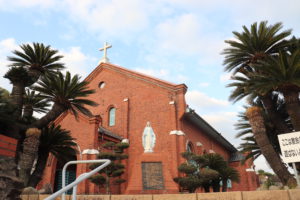
● Churches and CathedralsThe Church is located in Kurosaki district, where was place of the setting for Endo Shusaku’s novel Silence. In 1897, the foundations were laid down according to Father de Rotz’s design. Construction followed and in 1920 the church was completed. The followers built it brick by brick with their own hands. The modest design serves to bring out the beauty of the bricks. Experience the depth when you come inside and see the rib vault ceiling. The church’s stained glass also leaves a lasting impression.
-
-
Shitsu Church, in Sotome
2024/02/16
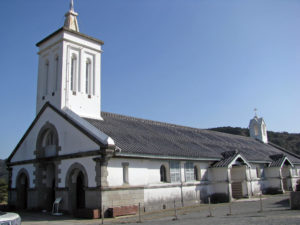
● Churches and CathedralsBuilt in 1882 by Father de Rotz, this low-ceiling church features a brick exterior, wood interior and stone entranceway. The roof itself is low in order to limit damage done by strong winds. The church’s bell was brought here from France by a priest and rings out beautifully every morning. The location is famous as the place where the movie “Gege” was filmed.
-
-
Yamada Church, in Hirado
2024/02/16
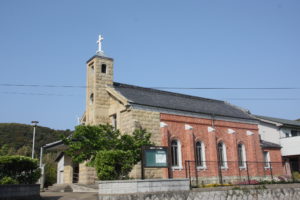
● Churches and CathedralsAfter the discovery of the numerous hidden Christians in Ikitsuki Island in 1865, they began to work on recovering their Catholic faith although they were not too successful at first. Then in 1878, a priest named Fr. Pelu came to Hirado and baptized many people who are said to be the ancestors of the churchgoers of Yamada Church today. The butterfly-wing decorations adorning the wall surface of the church interior was personally made and painted on by the priest at the time, and the mosaic-like paintings are made from actually, ground butterfly wings. These are considered as one of the church’s “seven sacraments.” In 1981, St. Thomas Nishi along with 15 other martyrs were beatified in the Philippines. St.Thomas was later canonized and a statue of him was built in commemoration of his canonization, in a garden in Ikitsuki.
-
-
St. Francis Xavier Memorial Church, in Hirado
2024/02/16
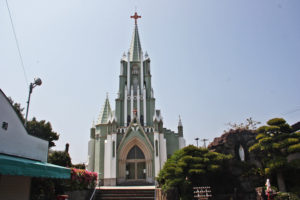
● Churches and CathedralsThis church is a catholic church in Hirado, Nagasaki. Hirado is a place where Francis Xavier visited 3 times in Japan to spread Christianity, and even during the Kinkyo Ordinance of the Edo Period that prohibited religions, Christianity was very widespread. For that reason when the ordinance was lifted this church was constructed, and the image of Francis Xavier was put on the side. One of the sites of the town is “the view of temples and church” which can be had halfway up the lane leading up the hill. The church was originally built on a different site in 1913, but was reconstructed at its present location in 1931.
-
-
Tabira Church, in Hirado
2024/02/16
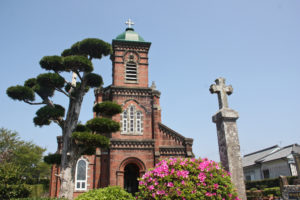
● Churches and CathedralsThe church is a Christian Pilgrimage site and was designed by Tetsukawa Yosuke, a famous architect of various churches in Nagasaki-prefecture, and built between December 1915 and October 1917. It is one of the latest brick churches in the prefecture of Nagasaki. Tetsukawa Yosuke has called this one of his best works. The beautiful building facing Hirado Strait offers artists and photographers a motif typical of the Tabira district. The church has been designated an important cultural asset by the Japanese government. The history of the Tabira district began with the work of two foreign missionaries. In 1886, the French missionary Emile Raguet, in charge of Kuroshima Church at the time, purchased one hectare (2.5 acres) of wilderness at his own expense and urged three families in need to settle there. The same year, Marc-Marie de Rotz of Shitsu Church bought one hectare and sent four families to cultivate the pristine land. Gradually the number of the settlers increased a nd reached 80 families by the early Taisho era (1910s). In 1914, the Japanese priest Nakata Tokichi arrived in the parish. To replace the humble prayer house, he made tremendous efforts to raise funds for a formal church. Tetsukawa Yosuke designed the brick building, and the parishioners cooperated in the construction project, gathering a large number of seashells and burning them into lime powder. The site of …
-
-
Urakami Cathedral, in Nagasaki
2024/02/16
● Churches and CathedralsConstruction of the original Urakami Cathedral, a brick Romanesque building, began in 1895, after a long-standing ban on Christianity was lifted. When completed in 1914, it was the largest Catholic church in East Asia. The Atomic bomb dropped on August 9, 1945 explored in Urakami, only 500m from the cathedral, which was completely destroyed. What remained of the cathedral is now on display in the Atomic Bomb Museum. A replacement was built in 1959, and remodeled to more closely resemble the original in 1980. The nearby the Ground Zero in Peace Park contains remnants of the Ruins of Urakami Cathedral
-
-
Japanese Castle
2024/02/16
Featured things in JapanJapaense Castles were built by the lords to show off their power and control their provinces. They were both residences and military bases. They were made of wood, but used various defensive devices for protection. For example, moats were built around some castles. In fact, moats around the Imperial Palace in Tokyo, which used to be Edo Castle, are still preserved.
 WhatsApp: Chat with us