
St. Francis Xavier Memorial Church
This church is a catholic church in Hirado, Nagasaki. Hirado is a place
where Francis Xavier visited 3 times in Japan to spread Christianity, and
even during the Kinkyo Ordinance of the Edo Period that prohibited
religions, Christianity was very widespread.
For that reason when the ordinance was lifted this church was constructed,
and the image of Francis Xavier was put on the side.
|
Francis Xavier visited here |
Catholic church in Hirado |
St. Francis Xavier statue |
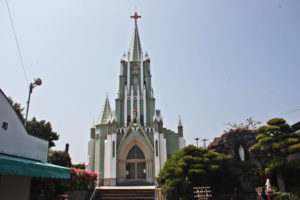


One of the sites of the town is “the view of temples and church” which can
be had halfway up the lane leading up the hill. The church was originally built
on a different site in 1913, but was reconstructed at its present location in 1931.
Design Your Kyushu Trip
We arrange custom Nagasaki & Kyushu Christian Pilgrimage Tours.
Connect below via your preferred method:
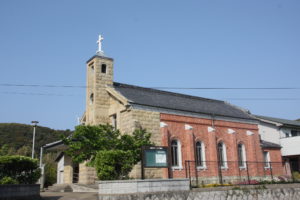
Yamada Church
After the discovery of the numerous hidden Christians in Ikitsuki Island
in 1865, they began to work on recovering their Catholic faith although
they were not too successful at first.
Then in 1878, a priest named Fr. Pelu came to Hirado and baptized
many people who are said to be the ancestors of the churchgoers of Yamad
a Church today.
 |
 |
 |
The butterfly-wing decorations adorning the wall surface of the church interior
was personally made and painted on by the priest at the time, and the
mosaic-like paintings are made from actually, ground butterfly wings.
These are considered as one of the church’s “seven sacraments.”
In 1981, St. Thomas Nishi along with 15 other martyrs were beatified in the
Philippines. St.Thomas was later canonized and a statue of him was built in
commemoration of his canonization, in a garden in Ikitsuki.
 |
 |
 |
Design Your Kyushu Trip
We arrange custom Nagasaki & Kyushu Christian Pilgrimage Tours.
Connect below via your preferred method:
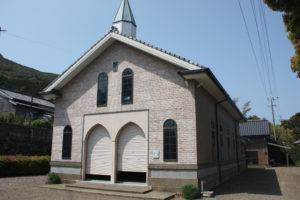
Yamano Church, in Hirado
Yamano Church was built in 1924 in the Yamano area, where is halfway
of Mount Yasuman. Most people living in this area are Christians.
 |
 |
 |
The ancestors of the Yamano village fled persecution from Nishisonogi
and Sotome to Goto island during ban on Christianity.
However, they were unable to live on Goto island, so they moved to
this area of Hirado Island between 1820 and 1830.
Design Your Kyushu Trip
We arrange custom Nagasaki & Kyushu Christian Pilgrimage Tours.
Connect below via your preferred method:
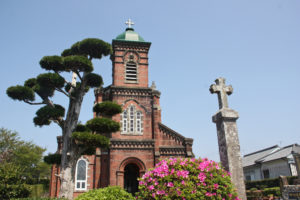
Tabira Church
The church is a Christian Pilgrimage site and was designed by Tetsukawa
Yosuke, a famous architect of various churches in Nagasaki-prefecture, and
built between December 1915 and October 1917. It is one of the latest brick
churches in the prefecture of Nagasaki. Tetsukawa Yosuke has called this one
of his best works. The beautiful building facing Hirado Strait offers artists and
photographers a motif typical of the Tabira district.
The church has been designated an important cultural asset by the Japanese
government.
 |
 |
 |
The history of the Tabira district began with the work of two foreign missionaries.
In 1886, the French missionary Emile Raguet, in charge of Kuroshima Church at the
time, purchased one hectare (2.5 acres) of wilderness at his own expense and urged
three families in need to settle there. The same year, Marc-Marie de Rotz of Shitsu
Church bought one hectare and sent four families to cultivate the pristine land.
Gradually the number of the settlers increased and reached 80 families by the early
Taisho era (1910s).
In 1914, the Japanese priest Nakata Tokichi arrived in the parish. To replace the
humble prayer house, he made tremendous efforts to raise funds for a formal church.
Tetsukawa Yosuke designed the brick building, and the parishioners cooperated in the
construction project, gathering a large number of seashells and burning them into lime
powder. The site of the processing ground still remains in front of the church.
Construction was finally completed under Tetsukawa’s supervision in 1918. The brick
church was the architect’s last in a long series of ecclesiastical works.
 |
 |
 |
Design Your Kyushu Trip
We arrange custom Nagasaki & Kyushu Christian Pilgrimage Tours.
Connect below via your preferred method:
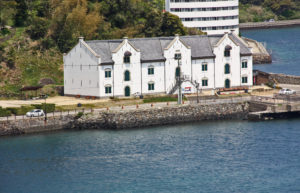
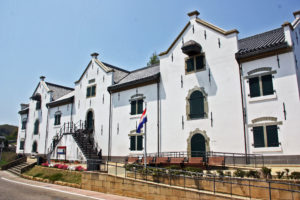
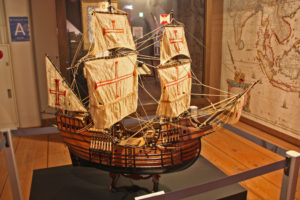
Dutch Trading Post
Set up in Hirado in 1609 as the base of operations of the Dutch East India Company in Japan.
The building seen today is a warehouse which was originally constructed here in 1639 as part
of the trading post, but torn down just three years later after the Dutch had been relocated to
Dejima Island in the port of Nagasaki.
 |
 |
 |
The warehouse was reconstructed in 2011. It was built as close to the original design as possible
and exhibits the facility’s original Dutch architecture of interlocking stone blocks supported by large,
exposed wooden beams. The structure is capped by a Japanese-style tile roof, just like the original.
 |
 |
 |
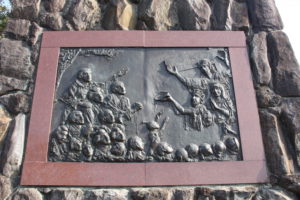
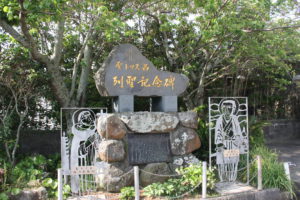
Kurose no Tsuji, martyrdom site of Gaspar Nishi Genka
The site where Christian Gaspar Nishi Genka was martyred in 1609, located on
Kurose Hill overlooking Nakae no shima between Hirado and Ikitsuki.
The tomb facing the sea is called Gaspar-sama and is a revered place for Ikitsuki’s
Hidden Christians.
The cross-shaped “Kurose no Tsuji Martyrdom Monument” was erected by Catholics
in 1991, and Mass is held every year around November 14th.
 |
 |
 |
Gaspar Nishi Genka was the first martyr of Ikitsuki and the father of Thomas Rokuzaemon
Nishi who was one of the 16 Saint of Nagasaki, dedicated in Nakamachi Church in Nagasaki.
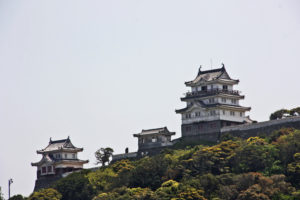
Hirado Castle
Stands on a hill guarding Hirado Port and the Hirado Strait, which used to be part of an important
trade route between Japan and the Asian mainland. The original fortress was built in 1599 by the
local Matsura Lord; however, he destroyed the structure after fighting the Tokugawa on the losing
side of the Battle of Sekigahara as a gesture of loyalty to the victor. The Matsura Clan continued
ruling Hirado for the next two and a half centuries.
 |
 |
 |
A new castle, also known as Kameoka Castle was built on the site a hundred years later in 1718 as
part of the coastal defences erected during Japan’s self imposed seclusion in the Edo Period.
This structure stood for over 150 years, but eventually fell into disrepair and was dismantled during
the Meiji Period.
 |
 |
 |
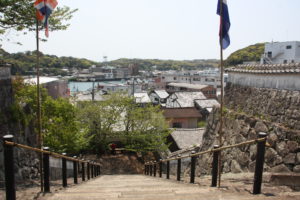
Matsura Historical Museum
The museum stores and displays the historical collection of the Matsura family who ruled
over the northern area of Nagasaki prefecture since the 13th century.
 |
 |
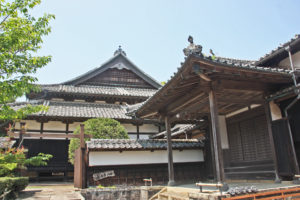 |
The museum is housed in the former private residence of the Matsura family, the grand
Tsurugamine Mansion, built in 1893. Hirado has a long history of overseas exchange due
to its geographical location.
 |
 |
 |
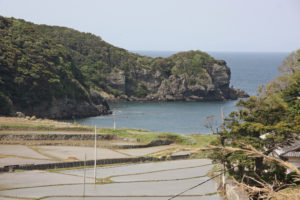
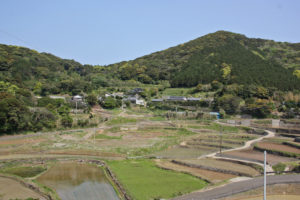
Kasuga Village / Hidden Christian Site
Kasuga Village and Mount Yasugatake is a Christian Pilgrimage site and is registered on
the World Heritage as Hidden Christian Sites in the Nagasaki Region.
 |
 |
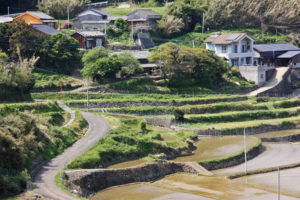 |
This idyllic, remote village was refuge to a small community of Hidden Christians who practiced here
for centuries, far from the prying eyes of the government. After the ban on Christianity was lifted, the
local villagers decided to continue practicing their own unique brand of the religion rather than rejoin
the Catholic Church. As a result, churches were not erected in the village, and the religion remains
outwardly invisible.
 |
 |
 |
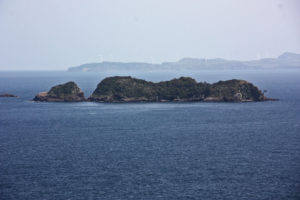
Nakae no Shima / Christian Pilgrimage site
Nakae no Shima is a Christian Pilgrimage site and is the UNESCO World Heritage site of
Hidden Chriatian Sites in the Nagasaki Region. Located two kilometers off the coast of
Hirado Island, Nakae no Shima is a small, uninhabited island where religious leaders
were executed during the persecution of Christians. The island is considered sacred,
and water collected there is used for baptism.
 |
 |
|

See more Reviews. Click on a page number below:
 WhatsApp: Chat with us